


Who Is Lord Jagannath? How Is He Different from Vishnu and Krishna?

Updated: Jul 13
-Understanding one of India's most distinctive and beloved sacred forms

Image by Puneet Sharma Courtesy Pexels
Many people first encounter Lord Jagannath through the Rath Yatra, a visit to Puri, or simply through that striking wooden form with its enormous round eyes. And many walk away with the same question: Is he the same as Krishna? A form of Vishnu? Why does he look so different?
Jagannath is widely understood in the Hindu tradition as a form of Vishnu, closely associated with Krishna.
And yet his worship, symbolism, rituals, and form carry a uniquely expansive identity, rooted in Odisha's living tradition and shaped by centuries of devotion, resisting any single theological category.
Who is Lord Jagannath?
The name itself is the beginning of an answer. Jagannath comes from Jagat (universe) and Nath (lord). He is, literally, the Lord of the Universe.
His primary home is the great temple at Puri in Odisha, one of the four sacred Char Dham pilgrimage sites, alongside Badrinath, Dwarka, and Rameswaram. That placement matters.
It tells you that Jagannath is not a fringe or regional deity but a presence at the very centre of Hindu sacred geography.
And yet what draws millions to Puri is not only duty or tradition. It is something harder to explain, a pull that devotees describe as deeply personal. A feeling, even in the middle of vast crowds, of being individually seen. Of arriving somewhere that was already waiting for you.
Is Jagannath the Same as Vishnu or Krishna?
Connected, but not interchangeable.
Within mainstream Hindu understanding, Jagannath is regarded as a form of Vishnu and deeply identified with Krishna in devotional tradition. But he is not simply a regional variant of the flute-playing form of Brindavan.
He carries something wider, a sacred identity shaped by the temple tradition of Puri, by Odishan cultural memory, by ritual practices distinctly his own.
Jagannath is connected to Vishnu and Krishna, but encountered through a tradition that gives him a uniquely inclusive, mysterious, and emotionally intimate presence.
There is something quietly powerful in that. We live in an age that equates worth with polish, with having it all figured out, with projecting certainty and completeness. Jagannath's very form pushes back against all of that.
Incompleteness does not diminish sacredness. There is grace in what remains unfinished.
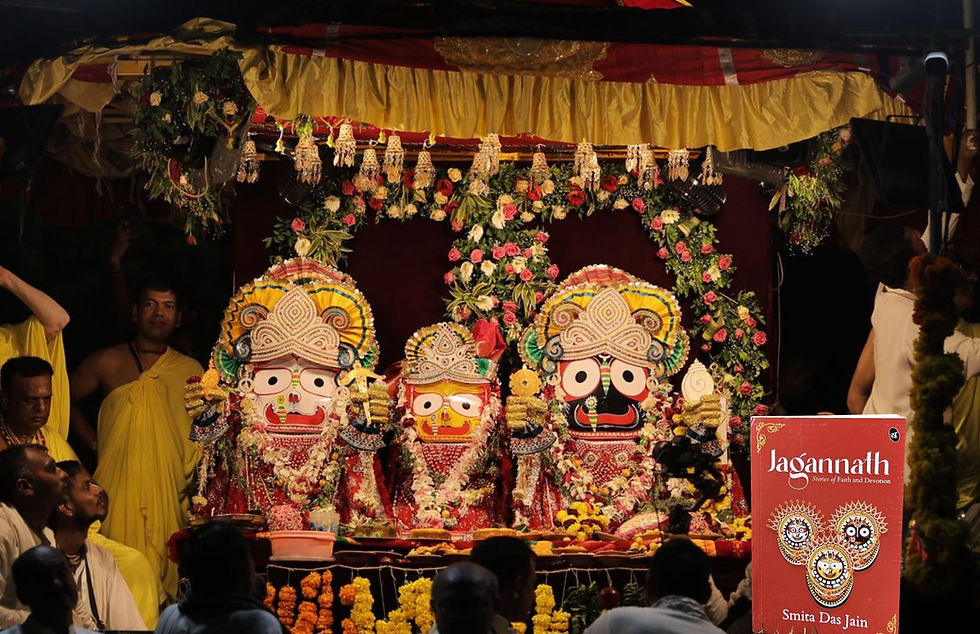
Why Does Jagannath Look So Different?

Image Courtesy Pexels
This is the question that stops most first-time visitors in their tracks.
Jagannath's form is wooden, unfinished by conventional sculptural standards. no hands, no feet, and none of the detailed realism of classical Hindu sacred art. And then there are those eyes. Enormous, round, and wide open.
For many people, the first encounter with that form produces something unexpected. Not the distant admiration one might feel before an ornate classical icon, but something closer and stranger, as though the image is looking back.
As though the usual relationship between viewer and deity has been quietly reversed. That quality is not accidental. It is, in many ways, the entire point.
The form has long invited layered interpretation, through theology, symbolism, and ritual history, and through the way the Jagannath tradition has absorbed multiple streams of worship across centuries.
The story behind the form, the divine craftsman, the interrupted creation, the sacred mystery at its heart, is one I explore in Jagannath: Stories of Faith and Devotion, which also traces the forms of his siblings, Balabhadra and Subhadra.

A story-led journey into the sacred world of Lord Jagannath.
Jagannath: Stories of Faith and Devotion
Why Is Jagannath Called the "Lord Beyond Form"?
This is not a fixed doctrinal title; it emerges naturally from the experience of the tradition.
Though Jagannath has a visible form, that form gestures beyond form. The unfinished body, the vast eyes, and the symbolic simplicity suggest a deity that conventional ideas of divine appearance cannot contain.
The tradition invites devotees to move from image toward meaning, from form toward presence.
Jagannath is called the Lord beyond form, because his form points beyond all narrow ideas of what the Divine should look like.
What Makes Jagannath Spiritually Distinct?
The word I keep returning to is accessibility.
Jagannath is not a distant or inscrutable presence. His tradition has always carried emotional intimacy, a sense that the Lord is close, compassionate, companion-like. Nothing expresses this more powerfully than Rath Yatra, when Jagannath does not wait for his devotees to come to him.
He comes out onto his great chariot, through the streets of Puri, accessible to all. The divine, in this tradition, moves toward the human.
That movement matters deeply to modern readers.
In an age of fragmentation and quiet spiritual hunger, the idea of a deity who comes to you, asking nothing of you first, speaks to something many people are carrying.
Jagannath offers reverence without distance, belonging without a prerequisite. His stories teach about life, faith and meaning to his devotees.
This is why he cannot be fully understood in the abstract. He is inseparable from Odisha, from Puri's layered ritual culture, and from the living tradition that has kept his stories alive for centuries.
The Last Word: Jagannath Is at Once Vishnu, Krishna, and Lord of the Universe
Jagannath is connected to Vishnu, identified with Krishna, enshrined at one of India's four great sacred sites, and is experientially more expansive than any one of those descriptions can hold.
His unfinished form is sacred. His vast eyes are intentional. His radical accessibility is exactly why he continues to fascinate devotees, seekers, and culturally curious readers alike.
If the world of Jagannath moves you, as story, symbolism, or presence, that is the space I enter in Jagannath: Stories of Faith and Devotion, bringing together lesser-known narratives and emotional truths for modern readers.
For those who wish to go deeper, it offers a more immersive way to encounter the Lord who feels at once intimate, mysterious, and beyond form.
A compelling collection of Jagannath stories that opens the door to one of India’s richest sacred traditions
Jagannath: Stories of Faith and Devotion
Related Articles:
Smita Das Jain is a writer by passion and an author of 6 books. Her debut short story collection 'A Slice of Life' was named among India’s top three fiction works in 2021. Her debut novel 'A Price to Love' came out in October 2022, followed by 'Twisted Tales and Turns' in July 2023, 'Till Fate Do Us Part' in August 2024 and 'Leading With Words' in September 2025. Smita's award-winning short stories have been featured in 18 anthologies around the globe. You can learn more about her writings at https://www.smitaswritepen.com/
Outside the world of writing, Smita is an Executive Coach and Life Coach enabling people to get better at what they do, a 3X TEDx speaker, a keynote speaker at prestigious corporate conferences and a guest columnist on personal development matters for leading magazines and platforms. You can learn more about 'Smita's Empower Your EDGE' coaching program at https://www.lifecoachsmitadjain.com/

Really enjoyed reading this article! The information is explained in a simple and engaging way, which makes the content both useful and easy to follow. I often browse different websites for interesting insights, and this post definitely stood out. Hoping to see more well-written and informative content like this soon!