


Jagannath Rath Yatra: Stories, Symbolism, and Spiritual Significance

-Understanding the spiritual meaning behind India's greatest chariot festival

Image by Barun Courtesy Pexels
If you have never heard of the Jagannath Rath Yatra before, here is the simplest way I can describe it: Once a year, Lord Jagannath leaves his temple in Puri and travels to the Gundicha temple, meeting people along the way.
He is not glimpsed through a window or carried behind closed doors, but out in the open, on the streets, visible to everyone who has made their way there.
I have spent a year reading, researching, and writing about Jagannath, and I find that the more I understand about this festival, the more it moves me. There is so much behind it that most people never get to hear: the stories, the symbols, the spiritual ideas that have made Rath Yatra one of India's most loved sacred traditions for thousands of years.
What Is Jagannath Rath Yatra?
Rath Yatra is celebrated every year in Puri, Odisha. The word Rath means chariot, and Yatra means journey. So, at its most basic, this is a festival of a sacred journey made by chariot.
Lord Jagannath, who is a form of Vishnu and is seen by many devotees as Krishna Himself, travels from the main Jagannath Temple to a smaller temple called the Gundicha Temple, about three kilometres away. The entire journey takes nine days.
He travels with His elder brother Balabhadra and His sister Subhadra, each on their own chariot. These chariots are built from scratch every single year using specific types of wood. They are massive structures, decorated in bright cloth, with wooden wheels, pulled by thousands of devotees gripping thick ropes.
What makes Rath Yatra genuinely different from most temple festivals is that the Lord comes out. In many Indian temples, entry to the inner sanctum is restricted. The divine is accessed by certain people, at certain times. Rath Yatra breaks all of that open. On this day, anyone can come. Anyone can pull the rope.
The accessibility and openness are woven into the very heart of who Jagannath is and what He represents.
The Stories Behind Rath Yatra
Every ritual has a story behind it, and Rath Yatra has more than one.
The story most people know is that the Gundicha Temple is the home of Lord Jagannath's maternal aunt. He goes there to visit her, to rest, and to spend time with his family members.
When you hear it that way, the whole procession looks different. This is not just a religious ceremony. It is the Lord going somewhere He loves, with his brother and sister beside him. Devotees who know this story do not feel like spectators. They feel like they are part of the group walking with Him.
Before Rath Yatra, there is a period called Anasara, lasting fifteen days, during which Lord Jagannath is said to be unwell. He withdraws from public view. Devotees do not get to see Him. And then, when He reappears just before Rath Yatra, He is freshly decorated, renewed, and ready to go out into the world again.
For people who have been waiting for that moment, and many wait with real longing, his reappearance is deeply emotional. The rest, the renewal, the return. It is a cycle that most of us, in our own lives, understand.

Image by Akash Mitra Courtesy Pexels
The Symbolism of the Chariots and the Journey
At one level, the chariots are simply magnificent wooden structures that carry Lord Jagannath, Balabhadra, and Subhadra from the Jagannath Temple to the Gundicha Temple. Yet, for centuries, devotees, saints, and scholars have found meanings in this journey that go far beyond the physical procession. Like many sacred traditions in India, Rath Yatra invites reflection rather than a single interpretation.
One of its most beautiful symbols is accessibility. For most of the year, the Lord resides within the temple's sanctum. During the Rath Yatra, however, he comes out to meet everyone. There are no distinctions of status, caste, language, or place of birth. The Divine steps into the streets, allowing those who may never enter the temple to stand before him. In many ways, the festival reminds us that spirituality is not always about seeking the Divine; sometimes, it is also about recognising that the Divine comes looking for us.
The chariot is a powerful symbol in Hindu tradition, and not just in Rath Yatra. It has also been understood as a symbol of life's journey. In the Bhagavad Gita, the chariot represents the human body, the horses are the senses, the reins are the intellect, and the one seated inside is the Self. So when you see Lord Jagannath riding his chariot through the streets of Puri, there is a philosophical idea alive inside that image, one that has been part of this tradition for centuries.
Just as the Lord leaves one abode only to return again, the festival reminds us that movement is not always about leaving something behind. Sometimes it is about deepening our relationship with what has always been ours.
Why Rath Yatra Feels So Unique?
Every major festival has its own rituals, traditions, and celebrations. But there is something about Rath Yatra that feels deeply personal. Perhaps it is because, for a few extraordinary days each year, the Lord leaves the sanctum of the temple and comes out to meet his devotees.
In most temples, devotees undertake the journey to seek the Divine. During Rath Yatra, that movement is beautifully reversed. Jagannath steps out into the streets, making himself accessible to everyone, those who can enter the temple and those who cannot, lifelong devotees and first-time visitors, the local resident and the traveller who has arrived from thousands of miles away. The festival dissolves many of the boundaries that ordinarily exist between the sacred and the ordinary.
The Gundicha Temple itself has a deeper meaning. Many devotees understand it as a symbol of the heart, the inner space that the Lord comes to rest in when it is ready to receive Him. In that reading, the entire journey of Rath Yatra becomes something personal.

Image by Dibakar Roy Courtesy Pexels
Perhaps that is what makes Jagannath so distinctive. He is revered as a great deity, yet he is loved like a member of the family. He falls ill during Anasara and is lovingly cared for. He travels to visit his aunt's temple during the Rath Yatra. He allows himself to be pulled by thousands of hands. Through these traditions, the Divine feels profoundly present, not distant and untouchable. He walks among people, shares their joys, accepts their devotion, and reminds them that sacredness is found in the ordinary spaces where life unfolds.
The Lord moves from the formal temple to the intimate space of the heart during India's greatest chariot festival.
What has also always moved me is the remarkable coexistence of scale and intimacy. Millions gather to witness the chariots, yet the experience rarely feels distant. Amid the chants, the sea of people, and the sheer grandeur of the procession, there is still the unmistakable feeling that every devotee has come for a personal meeting. It is a public celebration, but also a deeply private experience of faith.
It is this layered symbolism that makes the festival rich. On the surface, it’s a grand public celebration, but on the inside, it’s a personal and family affair.
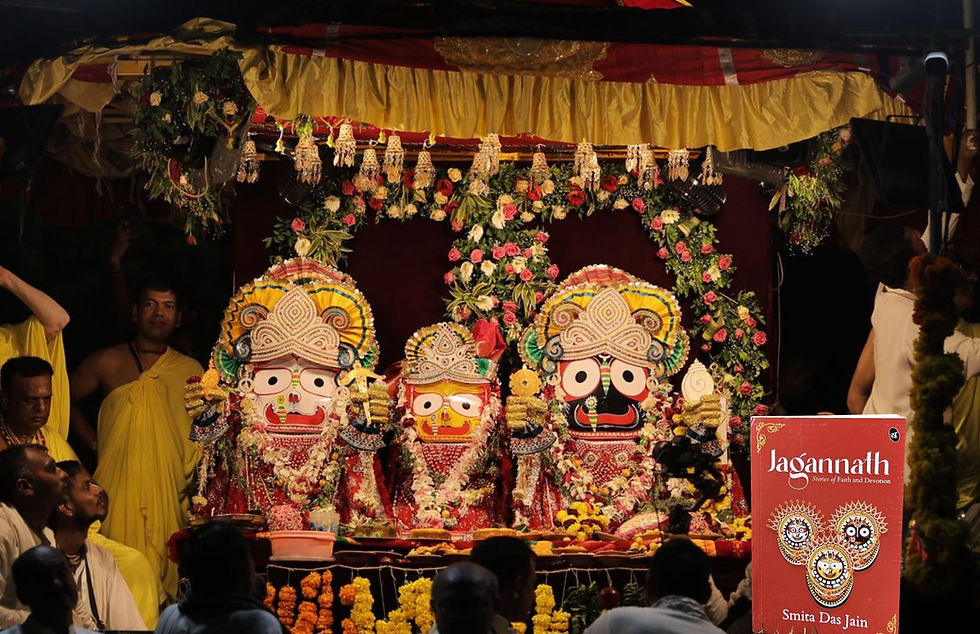
I explore the stories and celebrations of the festival in my book Jagannath: Stories of Faith and Devotion, which also offers glimpses of other festivals of the Lord.

A story-led journey into the sacred world of Lord Jagannath.
Jagannath: Stories of Faith and Devotion
The Spiritual Meaning Behind Rath Yatra
The simplest spiritual truth of Rath Yatra is also the most striking one: the Lord comes to you. You do not have to be the right person, from the right background, with the right credentials. He comes out to the street where you are standing, and he is there for you.
That idea of the grace of the divine moving toward the devotee rather than waiting to be reached is central to the Jagannath tradition. And Rath Yatra makes it visible in the most physical way imaginable. Pulling the rope of the chariot is considered an act of great devotion. But what I find beautiful about that image is what it actually looks like.
Thousands of ordinary people, all holding the same rope, all pulling together, moving something far larger than any one of them could move alone. You give your effort, you show up, and the chariot moves. There is a teaching in that which is hard to explain but easy to feel when you are there.
And then, nine days later, the Lord returns. The journey back, called Bahuda Yatra, is, for many devotees, the more tender of the two. Coming home after time away always carries its own feeling.
That return completes the cycle and, in completing it, reminds us that every journey outward, inward, or otherwise eventually comes home.
The Last Word: Rath Yatra Still Matters Today
Rath Yatra has been celebrated for thousands of years, and it continues to draw millions of people every year, not only from across India but from around the world. Part of that is faith, of course. But I think part of it is something more universal.
There is something deeply human about wanting to be part of something larger than yourself. About standing in a crowd of strangers, all there for the same reason. About holding a rope alongside someone you have never met and pulling together.
Rath Yatra gives people that experience, and it gives it wrapped in story and colour and music and centuries of meaning. For those who grew up with this festival, it carries memory, a parent's hand, a childhood morning, familiar chanting in a familiar voice.
For those coming to it for the first time, it carries the surprise of recognising something you did not know you were looking for.
Rath Yatra is a door. What lies behind it - the full world of Jagannath, His stories, His many forms, the philosophy, the devotion and the grace that runs through all of it, takes much longer to explore.
That is the journey I found myself on while writing Jagannath: Stories of Faith and Devotion. I went in wanting to understand a tradition. I came out with something I did not expect, a deep personal connection to a deity who, the more I learned about Him, felt less like a subject of study and more like a presence.
If Rath Yatra has piqued your curiosity, I hope you keep going. There is so much more to discover.
A compelling collection of Jagannath stories that opens the door to one of India’s richest sacred traditions
Jagannath: Stories of Faith and Devotion
Related Articles:
Smita Das Jain is a writer by passion and an author of 6 books. Her debut short story collection 'A Slice of Life' was named among India’s top three fiction works in 2021. Her debut novel 'A Price to Love' came out in October 2022, followed by 'Twisted Tales and Turns' in July 2023, 'Till Fate Do Us Part' in August 2024 and 'Leading With Words' in September 2025. Smita's award-winning short stories have been featured in 18 anthologies around the globe. You can learn more about her writings at https://www.smitaswritepen.com/
Outside the world of writing, Smita is an Executive Coach and Life Coach enabling people to get better at what they do, a 3X TEDx speaker, a keynote speaker at prestigious corporate conferences and a guest columnist on personal development matters for leading magazines and platforms. You can learn more about 'Smita's Empower Your EDGE' coaching program at https://www.lifecoachsmitadjain.com/

This was a well-written and informative post. I like how the topic was explained in a clear and easy-to-understand way. It’s helpful for readers who are new as well as those looking to learn something new. For anyone exploring similar topics and platforms, this resource is also worth a look: Fairplay