


What Jagannath Stories Teach Us About Life, Faith, and Meaning

Updated: Jul 13
-Six Lessons that are as alive today as they were centuries ago
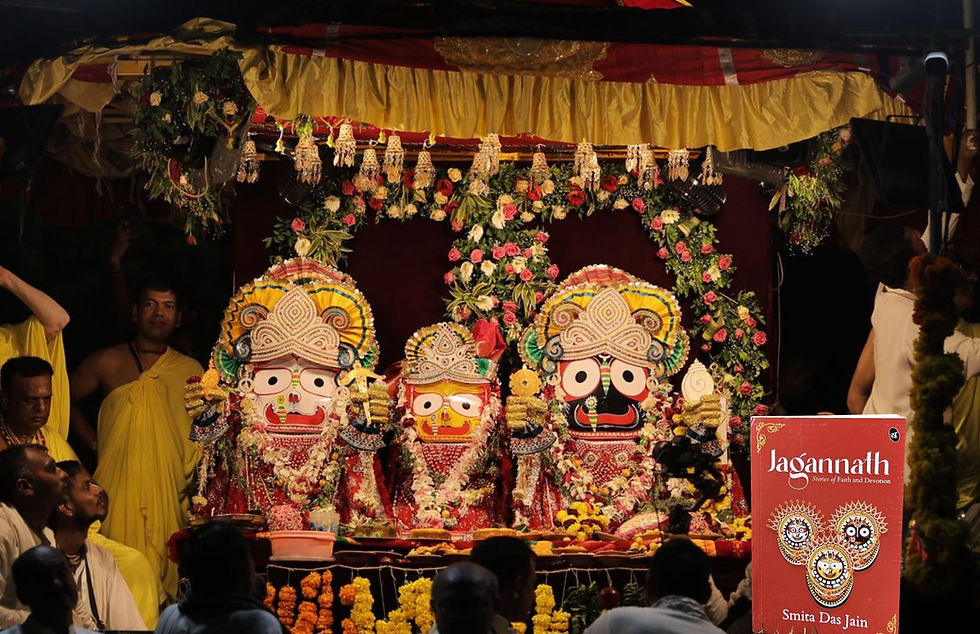
Who is Lord Jagannath? Is he the same or different from Vishnu and Krishna? That's the question many devotees have.
Lord Jagannath is one of India's most beloved and distinctive sacred forms. Worshipped primarily in Puri and deeply woven into the spiritual fabric of Odisha, he is connected to Vishnu and Krishna and yet experienced in a way that is uniquely his own.
What has always moved me about the Jagannath tradition is not just his antiquity or grandeur. It is the stories. Stories of longing and surrender, of grace arriving unexpectedly, of a divine presence that does not ask you to be perfect before it welcomes you.
These are not merely religious narratives preserved in old texts. They are living stories. And they still speak to our restlessness, our uncertainties, our hunger for meaning, our need to belong.
Why do Jagannath Stories Feel Different?
It is worth pausing to ask: why do Jagannath stories carry such a peculiar quality?
Part of the answer lies in the deity’s form. Jagannath's wooden image, unfinished, wide-eyed, deliberately unlike the sculpted realism of other Hindu deities, invites something different from a viewer. Not admiration from a distance, but closeness. A feeling of being seen rather than evaluated.
Part of it lies in the tradition's unusual blend of faith, folklore, ritual, and lived culture. Jagannath is not only worshipped inside the sanctum. He comes out into the streets during Rath Yatra, moving toward his devotees.
The divine, in this tradition, is not remote. It moves. It comes close. It makes itself accessible. And part of it lies in the stories themselves, full of human emotion, surprising grace, and a kind of radical inclusiveness that continues to feel radical even today.
6 Timeless Lessons Modern Readers Can Learn from Jagannath Stories
Everything Finished Is Not Perfect.
Jagannath's form, as every devotee knows, is unfinished. The legend goes that the divine craftsman Vishwakarma was at work and was interrupted before the image could be completed.
And yet, that unfinished form is the one that has been worshipped for centuries. That is the one that draws millions to Puri every year.
There is something quietly powerful in that. We live in an age that equates worth with polish, with having it all figured out, with projecting certainty and completeness. Jagannath's very form pushes back against all of that.
Incompleteness does not diminish sacredness. There is grace in what remains unfinished.
We Do Not Always Need to Be Certain to Believe.
Many of the stories surrounding Jagannath are built not on triumph or clarity, but on waiting, longing, and trust in what cannot yet be seen. Characters who do not fully understand what they are waiting for, but stay present anyway.
That feels remarkably modern to me.
We live in a world that rewards certainty that fills silence with noise rather than sitting with mystery. The Jagannath tradition suggests something different: that meaning does not always arrive immediately, and that faith is less about having answers than about remaining open in the presence of questions.
Meaning deepens when we stop demanding immediate answers.
Belonging Matters More Than Perfection.
One of the most distinctive aspects of the Jagannath tradition is its emotional accessibility.
Jagannath is not experienced as a distant, inscrutable, or intimidating presence. He is close. Companion-like. The stories reflect this; they are full of ordinary people, flawed people, people who arrive not with credentials but with devotion.
In a world where so many people feel like they are not quite enough, not successful enough, not spiritual enough, not certain enough, there is something deeply comforting in a tradition that says: you do not need to be perfect to belong here.
We are transformed by what makes us feel seen and welcomed, not by what judges us from afar.

A story-led journey into the sacred world of Lord Jagannath.
Jagannath: Stories of Faith and Devotion
There is Meaning Behind Rituals.
Modern readers, particularly those who have drifted from inherited traditions, often struggle with ritual. It can feel mechanical, inherited without explanation, disconnected from inner life.
What the Jagannath tradition offers is a different way of looking at this.
The rituals that surround Jagannath, and there are many – layered and ancient – are not arbitrary. They carry memory. They carry humility.
Jagannath rituals mark time in a way that resists the relentless forward pressure of modern life and says: pause here, remember, honour what is larger than you.
When ritual is understood rather than merely performed, it ceases to be repetition and becomes renewal.
What looks mechanical from the outside may be deeply alive from within.
5. Stories Carry What Information Cannot.
You can read a theology textbook about Jagannath. You can study the history of the Puri temple, its architecture, rituals, and philosophical traditions. All of that is valuable.
But none of it does quite what a story does.
A story lets you feel devotion. It lets you sit with longing, and grief, and the particular tenderness of a moment when grace arrives unexpectedly. Stories make sacred traditions emotionally accessible in a way that information alone never can.
This is precisely why I wrote Jagannath: Stories of Faith and Devotion. The book brings together stories, some lesser-known, some at the heart of the tradition, told in a way that speaks to modern readers. Not as doctrine, but as a living narrative. As an invitation to feel your way into a world that information alone cannot open.
Rootedness Still Matters in Modern Life.
There is a kind of fragmentation that characterises modern life, a feeling of being hurried, untethered, disconnected from anything older or slower than the present moment.
Jagannath stories do not offer nostalgia as a solution to that. They offer something more useful: rootedness. A reminder that we are part of something larger than our current pressures and preoccupations. That life has always been uncertain, and that people before us have found ways to live with beauty and meaning inside that uncertainty.
In an age of shallow content and constant distraction, there is something revolutionary about returning to a tradition that has been asking the deep questions for centuries.
To live fully in the present, we sometimes need to reconnect with what has and will outlive us.
The Last Word: Why Jagannath Stories Still Matter Today?
I keep returning to this question. And every time I do, the answer feels more urgent, not less.
Jagannath stories matter because they speak directly to the inner restlessness, spiritual dryness and the longing for meaning that productivity cannot fill that so many of us are carrying right now.
Stories about the Lord fill the human need to belong somewhere without having to earn that belonging first and fulfil the desire for reverence that does not feel distant, gatekept, or cold.
In an age that is long on information and short on wisdom, stories that carry faith, grace and the full complexity of human experience are not a luxury. They are a necessity.
I wrote Jagannath: Stories of Faith and Devotion to help modern readers encounter Jagannath not only through ritual or information, but through story, symbolism, memory, and emotional truth.
I invite you to its world, and hope it finds you at the right moment.
A compelling collection of Jagannath stories that opens the door to one of India’s richest sacred traditions
Jagannath: Stories of Faith and Devotion
Related Articles:
Smita Das Jain is a writer by passion and an author of 6 books. Her debut short story collection 'A Slice of Life' was named among India’s top three fiction works in 2021. Her debut novel 'A Price to Love' came out in October 2022, followed by 'Twisted Tales and Turns' in July 2023, 'Till Fate Do Us Part' in August 2024 and 'Leading With Words' in September 2025. Smita's award-winning short stories have been featured in 18 anthologies around the globe. You can learn more about her writings at https://www.smitaswritepen.com/
Outside the world of writing, Smita is an Executive Coach and Life Coach enabling people to get better at what they do, a 3X TEDx speaker, a keynote speaker at prestigious corporate conferences and a guest columnist on personal development matters for leading magazines and platforms. You can learn more about 'Smita's Empower Your EDGE' coaching program at https://www.lifecoachsmitadjain.com/


Really enjoyed reading this article! The information is explained in a simple and engaging way, which makes the content both useful and easy to follow. I often browse different websites for interesting insights, and this post definitely stood out. Hoping to see more well-written and informative content like this soon!